
Sewer & Drain
Drain clearing, camera inspection, and repair.
Coastal-grade work, done right.
Slow drains and backups are more than an annoyance — they're your home telling you something. We clear, inspect, and repair sewer and drain lines with modern camera diagnostics, so we find the actual cause instead of guessing. When a line is damaged, we'll walk you through your options, including trenchless repair that fixes the pipe without tearing up your yard, driveway, or landscaping.
A slow drain is a nuisance. A backed-up main line is a real problem, one that can push wastewater up into your tubs, showers, and floor drains. Often the clog you can see at the sink isn’t the actual issue. It’s further down, in a branch drain or the main sewer that ties the whole house together, and clearing it properly means finding exactly where it is and why it happened.
Good Catch Plumbing handles the full range of sewer and drain work: clearing stubborn clogs, running a camera through the line to see what’s really going on, and repairing or replacing pipe when a snake or jetter isn’t enough. We serve homes across Sanibel, Captiva, Fort Myers, Cape Coral, Naples, and the rest of Southwest Florida, from newer slab-built houses to older properties still running their original cast-iron drain lines.
Signs your sewer or drain line needs attention
More than one drain is slow
When several fixtures back up at once, the clog is usually in the shared main line rather than any single drain. That points to a bigger problem than one slow sink.
Gurgling toilets or drains
Air trapped by a partial blockage makes toilets bubble and drains gurgle when water runs elsewhere in the house. It often means the main line is starting to close up.
Sewage smell indoors or in the yard
A sewer-gas odor can point to a cracked line, a dried-out trap, or a venting problem. It's worth checking rather than ignoring.
Water backs up when you flush
If flushing the toilet pushes water up into a tub or shower, wastewater has nowhere to go and is backing up through the lowest fixture in the home.
Clogs that keep coming back
A drain you clear again and again is telling you something structural is wrong: root intrusion, heavy scale buildup, or a bellied section of pipe holding water.
Soggy or unusually green patches in the yard
A spot of lawn that stays wet or grows faster than the rest can sit right over a leaking underground sewer line.
What's included
- Drain clearing & cable snaking
- Camera line inspection & locating
- Trenchless sewer repair options
- Root intrusion removal
How we handle sewer and drain work
We find the problem before we fix it
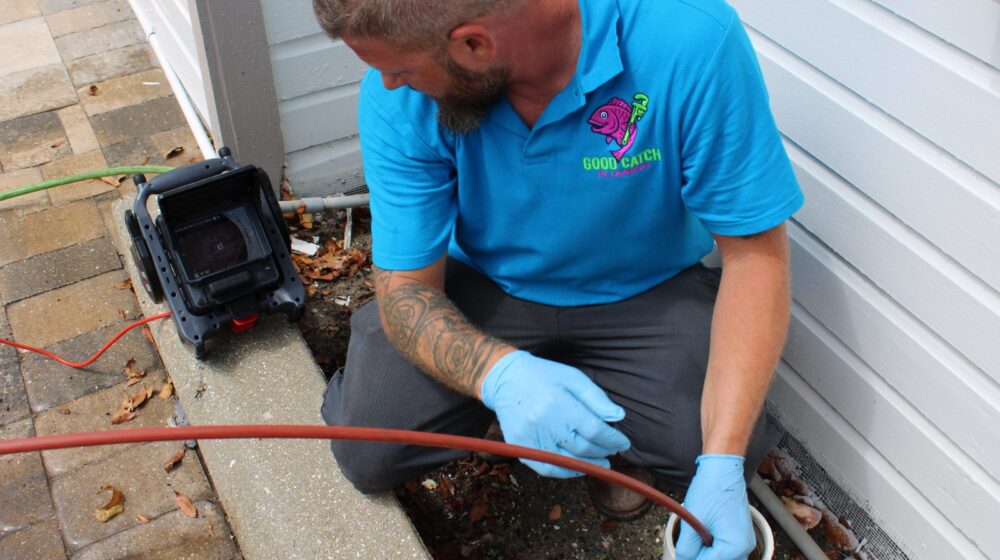
Guessing gets expensive. When you have a recurring clog or a main-line backup, we run a camera down the line so we can see the inside of the pipe on a monitor. That shows us what we’re actually dealing with, whether it’s grease, a foreign object, root intrusion, mineral scale, or a section of pipe that has cracked or sagged. It also tells us how far down the trouble sits and what the pipe is made of, so any repair is based on what’s really there instead of a hunch.
Clearing the line, and keeping it clear
For most clogs we start with cabling: running a motorized snake with the right cutting head to break through the blockage and pull it back. When a line is coated with years of grease, scale, or root hair, cabling punches a channel through the buildup but leaves the pipe walls fouled, so it clogs again before long. In those cases we recommend hydro jetting, which uses high-pressure water to scour the pipe back toward full diameter. We match the method to the pipe. Older cast-iron lines can be fragile, so they get a more careful approach than modern PVC.
Repairs and replacement
When the camera shows a broken, collapsed, or root-invaded section, clearing it is only a temporary fix. We’ll show you the footage, explain your options in plain terms, and give you honest, upfront pricing before any digging starts. Depending on the situation that can mean a spot repair to replace one bad section or a larger replacement of the run.
What’s different about Southwest Florida
A lot of homes here still run original cast-iron drain lines that are decades old. Our hard, mineral-heavy water speeds up scale buildup inside them, and the metal corrodes and flakes from the inside out. Flat terrain means drain lines sit at a shallow slope, so waste moves slowly and solids tend to settle. On top of that, tree and shrub roots seek out the moisture inside sewer joints, and seasonal homes that sit empty for months develop dried-out traps and sluggish lines. We take all of that into account instead of treating every clog the same.
How it works
-
1
Call or Book
Reach a real person and tell us what’s going on. We’ll schedule a time that works for you.
-
2
Diagnose & Quote
We inspect, explain the real issue in plain language, and give you an upfront price.
-
3
Fix It Right
We do the work cleanly, test it, and stand behind it with our guarantee.
Why choose Good Catch
We look before we dig
A camera inspection shows the real cause on screen, so you're not paying to replace pipe that isn't broken or to re-clear a clog that keeps returning.
Built for local pipes
We know how our hard water, sandy soil, and aging cast-iron lines behave, and we adjust our methods for older Southwest Florida homes instead of forcing a one-size approach.
Straight answers, upfront pricing
We show you what we find, explain your options honestly, and price the work before we start. No surprise upsells and no pressure.
Licensed and insured
Good Catch is a Florida Certified Plumbing Contractor, license #CFC1434636, so sewer and drain work is done to code and backed by our workmanship guarantee.
Questions
Questions about Sewer & Drain
Why does my drain keep clogging even after I clear it?
Do you use a camera to inspect the sewer line?
What is hydro jetting, and do I need it?
Can tree roots really get into my sewer pipe?
How do you repair a sewer line that runs under my slab?
My seasonal home sat empty for months and now the drains smell. What's wrong?
Ready to book your service?
Call us or request a visit — we serve all of Southwest Florida, 7 days a week.